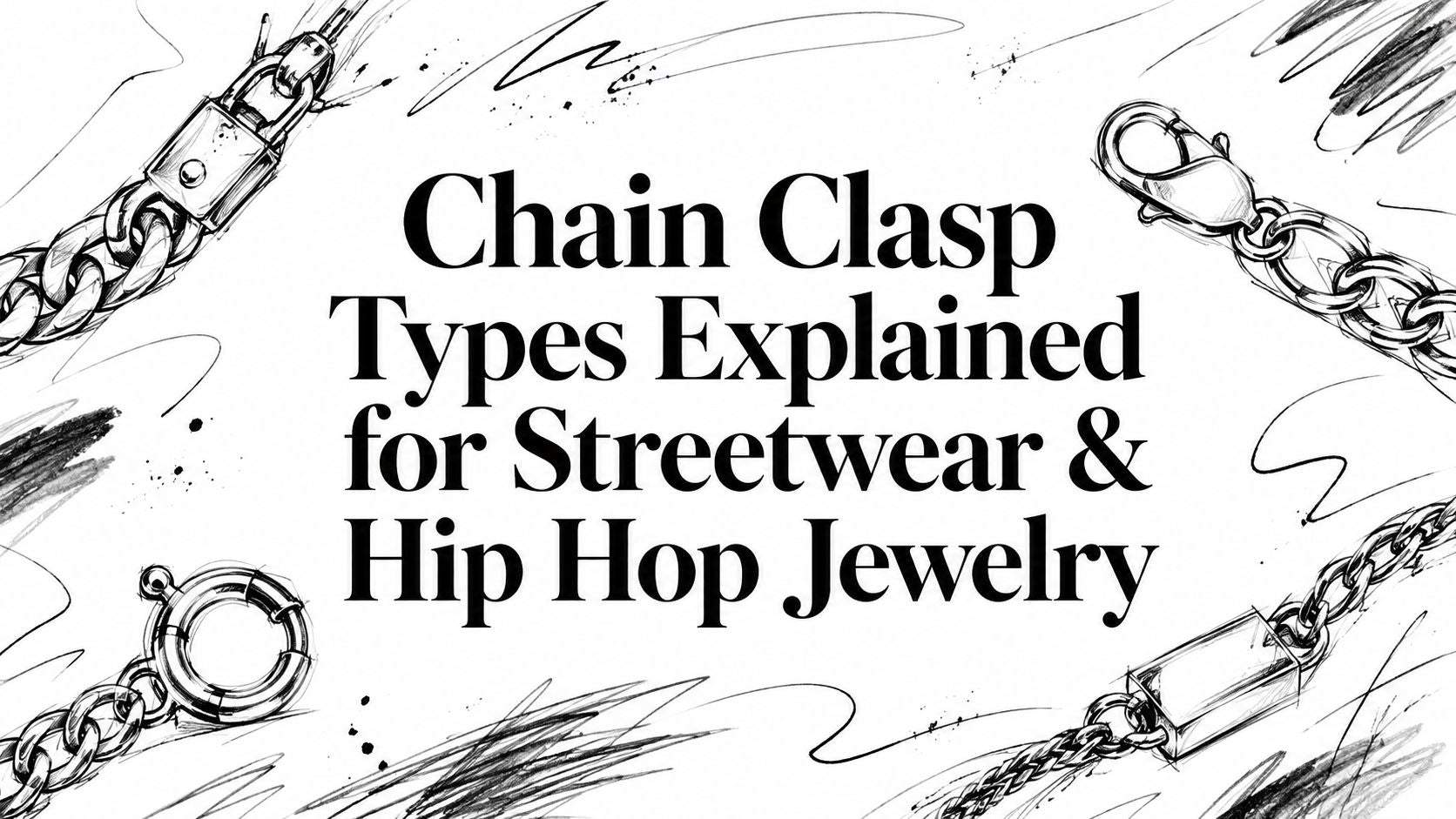
Chain Clasp Types Explained for Streetwear & Hip Hop Jewelry
You're about to wear a chain that looks perfect in the mirror and feels heavy in the hand, but one weak clasp can ruin the whole piece in a second. I've seen people baby a Cuban link all night, then lose it because the closure was a cheap spring ring that gave out during a tug, a hug, or a dance-floor catch. If you wear streetwear jewelry hard, the clasp isn't a detail, it's the part that decides whether your chain stays on your neck or ends up on the ground.

Why Your Clasp Choice Matters More Than You Think
Shoppers love to focus on link width, length, and how the chain sits on the chest, then they accept whatever clasp comes attached. That order is wrong. The clasp is the mechanical heart of the piece, the part that decides whether the chain stays on you or ends up on the floor. On heavy streetwear chains, a weak closure is a real failure point, especially when you are moving through crowds, at shows, in clubs, or anywhere sleeves and pendants get yanked by accident.
A chain can be all solid metal and still fail at the smallest moving part. As the chain gets heavier, the clasp has to handle more pull, more twist, and more repeated opening and closing. The links cannot rescue you if the closure pops open under stress.
Practical rule: if the chain is valuable enough to make you nervous when you wear it, the stock clasp is not automatically good enough.
The historical record backs that up too. Clasp styles changed with the era, so clasp type can help narrow a piece's likely age when other clues are missing. One dating guide places the spring ring as common from 1902–present, the box clasp from 1920–1960, and the lobster claw from 1970–present. Another antique timeline places the spring ring or bolt ring in the 1840s, the tube clasp in the mid-19th century, and the lobster clasp as a 1970s innovation. Navette Jewellery's clasp dating guide lays out that range and shows the shift from earlier hand-finished closures to later standardized hardware.
For streetwear buyers, the call is simple. Spring rings fit lighter or older-style pieces, lobster clasps are the modern default, and box clasps belong on chains where security matters more than keeping the hardware small. On heavy Cuban links and rope chains, I want the clasp to look like it can take punishment, because that is exactly what the chain will get.
Every Common Chain Clasp Type Defined

The closures you'll actually run into
Lobster clasp. This is the curved, trigger-style closure many recognize right away. You press the tiny lever, the claw opens, then snaps shut when released. It's common on modern chains because it balances speed and reliability.
Spring ring. This is the round clasp with a small lever and an internal spring. It's compact and light, which is why it shows up on delicate necklaces and bracelets. It's also the one many people fumble, especially with bigger fingers or low light.
Box clasp. This uses a tongue that slides into a box-shaped receiver and locks with tension. It sits flatter than a lot of other closures, so it blends well into dressier or heavier pieces. On Cuban links, it's one of the most serious options.
Fold-over clasp. This is a hinged tab that folds over and locks in place, often with a safety latch. You see it on heavier bracelets and some premium wrist pieces because the shape spreads stress well.
Toggle clasp. This is the bar-and-loop system where a T-bar passes through a ring. It's easy to use and looks intentional, almost like jewelry and hardware were designed together.
Magnetic clasp. Two magnetized ends snap together. It's simple to fasten, which is why people with limited hand strength like it, but it's not my first pick for heavy streetwear pieces.
The rest of the field
S-hook clasps are simple hooks that catch into a loop or ring, which makes them easy to adjust but less secure for heavy wear. Barrel clasps screw or twist together in two cylindrical pieces, and they're common on smaller or medium pieces that need a neat profile. Snap clasps and push-button clasps rely on a spring release, which makes them convenient but dependent on internal parts staying crisp. Fishhook clasps and carabiner-style closures are usually seen in fashion-forward or utility-inspired jewelry, where the visual line matters almost as much as the lock itself.
If you're shopping fast, remember this: lobster and box clasps are workhorses, spring rings are for lighter duty, and decorative closures should never be trusted just because they look tougher than they are.
Strength and Security Comparison Across Clasp Types
A chain can look heavy and still fail at the clasp. That is the part I judge first on streetwear pieces, because Cuban links, rope chains, and other daily-wear chains get tugged, twisted, and pulled more than most jewelry. The closure has to match the weight and the wear pattern, or it becomes the weak point.
For light chains, a spring ring can do the job if the piece stays small and the wear is gentle. A lobster clasp is the safer everyday choice for most chains because it gives you a better grip and more reliable retention without getting bulky. On heavier pieces, box clasps win on security because the tongue-and-box fit holds firm under load, and a double-locking version adds another layer of retention. That is the setup I trust when the chain carries real mass and gets worn often.
| Clasp Type | Tensile Strength | Security Features | Best For |
|---|---|---|---|
| Spring Ring | Around 6–10 lb | Small spring-loaded closure, compact profile | Delicate chains, lightweight pieces |
| Lobster Clasp | Around 12–18 lb | Spring-trigger claw, easy daily use | Everyday chains, medium-weight jewelry |
| Box Clasp | Around 20–30+ lb | Precision tongue-and-box fit, can include safety catch | Heavier chains, valuable pieces |
| Box Clasp, double-locking variant | Higher security margin, about 40% more | Secondary lock adds retention | High-value jewelry, loss-sensitive wear |
| Fold-over Clasp | Not quantified in the verified data | Hinged closure, often paired with safety latch | Heavy bracelets, premium wrist pieces |
The split is simple. A heavier chain puts more stress on the closure every time it moves, and repeated tugging makes a weak clasp show problems fast. That is why a box clasp belongs on heavier gold or platinum bracelets and other substantial pieces, while a lobster clasp is better suited to daily chains that need speed and dependable hold. One buying guide places box clasps above lobster claws in controlled pull tests and recommends the box style for heavier work, which is exactly the kind of mechanical edge you want on valuable streetwear jewelry. Alibaba's clasp buying guide
Heavy metal needs a heavier lock. If the clasp is under-rated, the chain does not care how good the links look.
Professional durability should be measured by pull force and repeated use, not by shine. A clasp that survives real wear has to keep working after constant opening and closing, and it has to hold up when the chain gets jerked, snagged, or slept in. That is the standard that matters on pieces meant for daily wear, and it is the same practical view used by CaratX and SJ Jewellery's clasp guide.
Best Clasp Recommendations for Popular Chain Styles

Cuban links and rope chains need different thinking
Cuban links are the most obvious case for a serious clasp. Heavy Cubans should get a box clasp or a fold-over clasp if the piece is especially substantial, because the closure has to match the weight of the chain instead of just looking clean. That's exactly where the internal chain mass and repeated wear make the clasp the weak link, not the links themselves. For a deeper style comparison, this internal guide on rope chain vs box chain is worth reading alongside the clasp choice.
Rope chains are different. They're twisty, visually busy, and usually worn as daily pieces rather than trophy hardware. A lobster clasp is the practical pick here, with a spring ring only if the chain is very light and the wearer wants a smaller profile. Figaro chains sit in the middle, and a lobster or barrel clasp works well because the closure stays secure without fighting the rhythm of the links.
Match the closure to the way the chain gets worn
Tennis chains need a clasp that stays quiet and secure under constant movement, so box-style hardware is the cleaner recommendation. Micro chains are the opposite, they need lightweight hardware that doesn't overpower the piece, which is why a spring ring or compact lobster fits better. Chokers deserve special attention because they get tugged more often during wear and removal, so a clasp that's easy to reach but doesn't pop open under motion matters more than flash.
For pendant-heavy necklaces, I prefer a box clasp if the pendant has real weight. The clasp has to handle not just the chain, but the pull created by the pendant hanging off-center. If the piece is purely fashion-weight and the pendant is small, a lobster clasp is acceptable, but I'd still inspect the spring before buying.
A quick note on the embedded video below, it's useful if you're comparing clasp style to chain construction and trying to see how the closure changes the whole look.
Bottom line, don't match clasp by trend. Match it by chain mass, wear frequency, and how angry you'd be if the piece opened once.
Sizing Installation and Maintenance Tips

A clasp can be strong on paper and still fail on the chain if the fit is wrong. The connection has to suit the chain width, the jump ring, and the closure body all at once. If the clasp sits crooked or forces the end link to twist, wear builds in one spot and the failure comes faster.
What good setup looks like
- Match the clasp to chain width. The clasp should fit the end link cleanly, not hang off it like a repair that never got finished.
- Respect the weight load. Give the clasp more capacity than the chain needs in real wear, not just enough to shut once.
- Use soldered jump rings. A soldered connection cuts down weak points at the attachment.
- Clean it regularly. Use soap, a soft brush, dry it well, and check the spring or hinge while you're there.
For heavy streetwear chains, the setup has to match the load the piece will carry. A Cuban link or rope chain puts more stress on the closure than a light fashion chain, so the clasp has to sit straight and hold under repeated movement. As noted earlier in mens chain length chart, the way a chain hangs changes how much pull the clasp sees during wear.
A technical guide says the safest baseline is a clasp that can handle at least 5 kg of pull force and survive 1,000+ open and close cycles, so installation should support that kind of performance instead of fighting it. The material match matters too, especially with 925 silver, 14K, or 18K, because mismatched metals can wear unevenly over time. SJ Jewellery's maintenance guidance is solid on that point, and it lines up with what jewelers see in repairs.
If you already care about exact fit, compare it to sizing watch straps like a pro. The same pressure applies here, just with more expensive metal and more punishment from daily wear.
Inspect the spring, not just the shine. A polished clasp with weak tension is a liability dressed up as luxury.
The best maintenance habit is simple. Open and close the clasp a few times after cleaning, check for mushy resistance, and look for misalignment before it turns into a failure. If the closure feels loose, sticky, or lopsided, replace it before you lose the chain. On heavier pieces, that check matters even more, because a weak clasp usually gives out before the chain does.
Accessibility and Ease of Use for Daily Wear
A lot of people buy the strongest clasp on paper, then hate wearing the chain because it's hard to fasten. That's a bad trade. If you can't close it comfortably every day, you won't wear it, and a clasp that lives in a jewelry box is useless no matter how secure it looks.
Magnetic clasps earn their place with people who have reduced hand dexterity or just want one-handed fastening. Neutral jewelry guidance describes them as ideal for people who struggle with smaller latches, and that tracks with real use. The trade-off is obvious, though. They're easier to close, but you give up some confidence under heavy pull and rough movement, so I'd keep them for light pieces only. Valltasy's clasp guide makes that accessibility point clearly.
Ease of use versus grip security
Lobster clasps hit the sweet spot for a lot of buyers because they're easier to manage than tiny spring rings and still feel trustworthy on daily chains. Spring rings are compact, but many people with larger hands or weaker grip hate them. Toggle clasps are easy to handle and can be fastened more naturally, but they're not the first choice when the chain gets heavy or the wearer moves a lot.
If you need the chain to go on and off quickly, choose the clasp you can operate without help. If you need maximum security on a valuable piece, choose the stronger closure and accept that it may take a little more effort. That's the key decision. Convenience matters, but not more than the chance of loss.
The best clasp is the one you'll close correctly every time.
For streetwear buyers, I'd keep the rule simple. Magnetic for light, easy daily wear, lobster for the broad middle ground, and box clasp when the piece is too important to gamble with. If arthritis, one-handed dressing, or limited finger dexterity is part of your reality, accessibility is not a luxury feature. It's part of the spec.
Buying and Repair Advice for Streetwear Jewelry Shoppers
Check the clasp before you get excited about the chain. Open it, close it, feel the tension, and inspect how the end rings sit. If the connection looks sloppy, the gaps are visible, or the spring feels weak, walk away. Those flaws show up before a clasp fails, and they are a common reason jewelry comes back for repair.
If you are buying a heavier piece, do not pay for the chain and assume the closure is fine. Ask whether the clasp was chosen for the chain's weight or just matched to whatever the factory had on hand. A serious Cuban or rope chain deserves a closure that can keep up, and a solid sterling silver Cuban link chain should still be checked for a clasp that matches the piece instead of dragging it down. On heavy streetwear chains, a box clasp is usually the move because security matters more than convenience once the piece starts taking daily wear.
Repairs stay simple only when the damage is simple. A broken spring, bent tongue, or loose jump ring can often be fixed by a professional jeweler, but the metal has to match so the repair does not create new wear problems later. As noted earlier, 14K is a common standard for clasps because it holds up well without giving up too much value, while softer high-karat metal can wear faster in moving parts. That is why I would not guess on repairs for gold pieces, especially if the chain already gets worn hard.
If you are buying a new chain, judge the build first and the clasp second. If the seller cannot explain the closure clearly, or the clasp looks lighter than the rest of the piece, pass. A chain should feel finished and ready for real use, not patched together or underbuilt.
If you want chains that are built for real wear, not just photos, check out VVS Jewelry for streetwear-ready Cuban links, chokers, and custom pieces that hold up when you live in them. Choose the right chain, then choose the right clasp, because the lock on the back matters just as much as the shine on the front.